The Light Entertainment at the End of the Tunnel. Ridin' that train... yes, that train...

Monday, March 30, 2009

Geithner’s Dirty Little Secret

Geithner’s Dirty Little Secret By F. William Engdahl, 30 March 2009

US Treasury Secretary Tim Geithner has unveiled his long-awaited plan to put the US banking system back in order. In doing so, he has refused to tell the ‘dirty little secret’ of the present financial crisis. By refusing to do so, he is trying to save de facto bankrupt US banks that threaten to bring the entire global system down in a new more devastating phase of wealth destruction.

The Geithner Plan, his so-called Public-Private Partnership Investment Program or PPPIP, as we have noted previously (In German: Obamas Rettungsplan für die Banken: keine Lösung, sondern legaler Diebstahl), is designed not to restore a healthy lending system which would funnel credit to business and consumers. Rather it is yet another intricate scheme to pour even more hundreds of billions directly to the leading banks and Wall Street firms responsible for the current mess in world credit markets without demanding they change their business model. Yet, one might say, won’t this eventually help the problem by getting the banks back to health?

Not the way the Obama Administration is proceeding. In defending his plan on US TV recently, Geithner, a protégé of Henry Kissinger who previously was President of the New York Federal Reserve Bank, argued that his intent was ‘not to sustain weak banks at the expense of strong.’ Yet this is precisely what the PPPIP does. The weak banks are the five largest banks in the system.

The ‘dirty little secret’ which Geithner is going to great degrees to obscure from the public is very simple. There are only at most perhaps five US banks which are the source of the toxic poison that is causing such dislocation in the world financial system. What Geithner is desperately trying to protect is that reality. The heart of the present problem and the reason ordinary loan losses as in prior bank crises are not the problem, is a variety of exotic financial derivatives, most especially so-called Credit Default Swaps.

In 2000 the Clinton Administration then-Treasury Secretary was a man named Larry Summers. Summers had just been promoted from No. 2 under Wall Street Goldman Sachs banker Robert Rubin to be No. 1 when Rubin left Washington to take up the post of Vice Chairman of Citigroup. As I describe in detail in my new book, Power of Money: The Rise and Fall of the American Century, to be released this summer, Summers convinced President Bill Clinton to sign several Republican bills into law which opened the floodgates for banks to abuse their powers. The fact that the Wall Street big banks spent some $5 billion in lobbying for these changes after 1998 was likely not lost on Clinton.

One significant law was the repeal of the 1933 Depression-era Glass-Steagall Act that prohibited mergers of commercial banks, insurance companies and brokerage firms like Merrill Lynch or Goldman Sachs. A second law backed by Treasury Secretary Summers in 2000 was an obscure but deadly important Commodity Futures Modernization Act of 2000. That law prevented the responsible US Government regulatory agency, Commodity Futures Trading Corporation (CFTC), from having any oversight over the trading of financial derivatives. The new CFMA law stipulated that so-called Over-the-Counter (OTC) derivatives like Credit Default Swaps, such as those involved in the AIG insurance disaster, (which investor Warren Buffett once called ‘weapons of mass financial destruction’), be free from Government regulation.

At the time Summers was busy opening the floodgates of financial abuse for the Wall Street Money Trust, his assistant was none other than Tim Geithner, the man who today is US Treasury Secretary. Today, Geithner’s old boss, Larry Summers, is President Obama’s chief economic adviser, as head of the White House Economic Council. To have Geithner and Summers responsible for cleaning up the financial mess is tantamount to putting the proverbial fox in to guard the henhouse.

The ‘Dirty Little Secret’

What Geithner does not want the public to understand, his ‘dirty little secret’ is that the repeal of Glass-Steagall and the passage of the Commodity Futures Modernization Act in 2000 allowed the creation of a tiny handful of banks that would virtually monopolize key parts of the global ‘off-balance sheet’ or Over-The-Counter derivatives issuance.

Today five US banks according to data in the just-released Federal Office of Comptroller of the Currency’s Quarterly Report on Bank Trading and Derivatives Activity, hold 96% of all US bank derivatives positions in terms of nominal values, and an eye-popping 81% of the total net credit risk exposure in event of default.

The five are, in declining order of importance: JPMorgan Chase which holds a staggering $88 trillion in derivatives (€66 trillion!). Morgan Chase is followed by Bank of America with $38 trillion in derivatives, and Citibank with $32 trillion. Number four in the derivatives sweepstakes is Goldman Sachs with a ‘mere’ $30 trillion in derivatives. Number five, the merged Wells Fargo -Wachovia Bank, drops dramatically in size to $5 trillion. Number six, Britain’s HSBC Bank USA has $3.7 trillion.

After that the size of US bank exposure to these explosive off-balance-sheet unregulated derivative obligations falls off dramatically. Just to underscore the magnitude, trillion is written 1,000,000,000,000. Continuing to pour taxpayer money into these five banks without changing their operating system, is tantamount to treating an alcoholic with unlimited free booze.

The Government bailouts of AIG to over $180 billion to date has primarily gone to pay off AIG’s Credit Default Swap obligations to counterparty gamblers Goldman Sachs, Citibank, JP Morgan Chase, Bank of America, the banks who believe they are ‘too big to fail.’ In effect, these five institutions today believe they are so large that they can dictate the policy of the Federal Government. Some have called it a bankers’ coup d’etat. It definitely is not healthy.

This is Geithner’s and Wall Street’s Dirty Little Secret that they desperately try to hide because it would focus voter attention on real solutions. The Federal Government has long had laws in place to deal with insolvent banks. The FDIC places the bank into receivership, its assets and liabilities are sorted out by independent audit. The irresponsible management is purged, stockholders lose and the purged bank is eventually split into smaller units and when healthy, sold to the public. The power of the five mega banks to blackmail the entire nation would thereby be cut down to size. Ooohh. Uh Huh?

This is what Wall Street and Geithner are frantically trying to prevent. The problem is concentrated in these five large banks. The financial cancer must be isolated and contained by Federal agency in order for the host, the real economy, to return to healthy function.

This is what must be put into bankruptcy receivership, or nationalization. Every hour the Obama Administration delays that, and refuses to demand full independent government audit of the true solvency or insolvency of these five or so banks, inevitably costs to the US and to the world economy will snowball as derivatives losses explode. That is pre-programmed as worsening economic recession mean corporate bankruptcies are rising, home mortgage defaults are exploding, unemployment is shooting up. This is a situation that is deliberately being allowed to run out of (responsible Government) control by Treasury Secretary Geithner, Summers and ultimately the President, whether or not he has taken the time to grasp what is at stake.

Once the five problem banks have been put into isolation by the FDIC and the Treasury, the Administration must introduce legislation to immediately repeal the Larry Summers bank deregulation including restore Glass-Steagall and repeal the Commodity Futures Modernization Act of 2000 that allowed the present criminal abuse of the banking trust. Then serious financial reform can begin to be discussed, starting with steps to ‘federalize’ the Federal Reserve and take the power of money out of the hands of private bankers such as JP Morgan Chase, Citibank or Goldman Sachs.

Anfang_top

Wednesday, March 25, 2009

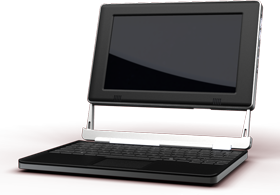
Everex XT5300T CPU Upgrade

My Everex XT5300T (the same beastie more or less is sold by OCZ as an OCZNBAN17DIYA) came with an Athlon 64 X2 TK-53. I just dropped in a Turion TL-62. I decided to note this because when I started considering trying this, Everex had nothing useful to say about it, and what little I could find on the net seemed to indicate that it either couldn't be done, or that a faster chip would probably run too hot. Hopefully other interested parties will find this post and be thereby heartened in their quest.

Let me first note that I tried a Turion RM-70. It's a nice-sounding chip, but not backwards-compatible. AMD should really call it something other than a Turion.

The Athlon TK series are sort of dumbed-down Turion TLs: they have 512K L2 cache instead of 1024K, and the TL-62 at least has five settable speeds (800 1600 1800 2000 2100), whereas the TK-53 just has three (800 1600 1700). Also, according to Wikipedia, the TK series don't support AMD-V, which probably means they are no good for virtual machines.

Judging by what baud-rate a kernel compile looks like (for those who remember back to things like 1200-baud terminals), it is quite a bit quicker, more than one would expect from an extra 400Mhz (x 2) of CPU. I figured the cache would make more of a difference than the clock speed. Another nice thing is that I've got two OCZ DDR-800 sticks in this thing, which with the old cpu, memtest86+ saw as 340MHz (DDR-681). The new chip turns them into 420MHz DDR-841. Definitely a quicker box, well worth the trouble.

The OCZ version of this laptop is a DIY thingie, meaning you are meant to finish it to your own satisfaction. While they ship it with the TK-53 cpu, they have a very nice DIY Handbook which shows not only how to add memory and disk, but also how to change the cpu. I picked up some Artic Silver Ceramique themal paste for about $2.50 and a Turion Tl-62 for $55, both from Ebay.

I was worried I might have a cooling problem (the TK-53 is listed as a 31 Watt TDP chip and the Tl-62 is 35 Watt TDP) but the Tl-62 is running if anything cooler than the TK-53 (the high-grade thermal paste may be helping with that). Judging by how cool the TL-62 is running, I'm sure I could get away with a TL-64 (not worth switching to go from 21.Ghz to 2.2 Ghz), and maybe anything up to a TL-68. If anyone tries anything faster than a TL-62, please let me know your results.

The exact chip I have is the TMDTL62HAX5DM. The DM is a later stepping than the DC, so that may be a factor in how hot or cool it runs, but probably not.

Sunday, March 08, 2009

"We are nowhere near a solution to the crisis"

FT.com / Columnists / Wolfgang Munchau - An L of a recession – reform is the way out
We are nowhere near a solution to the crisis. After committing errors of omission, global leaders are now producing errors of commission. The Americans dream about a return to a world of credit finance consumption while the Germans dream about assembly lines. In an L-shaped world, these are nightmares.


Reuters: Setback for America’s pro-Israel hawks

Setback for America’s pro-Israel hawks By: Bernd Debusmann ....

Signs are that its influence might be waning under the administration of President Barack Obama. Does that mean the days of unquestioning American support for Israel are coming to en end? Probably not.

But the furious reaction to Freeman’s appointment from some of the most fervent neo-conservative champions of Israel points to considerable concern over the possible loss of clout.

....

In the 60 years since its establishment on May 14, 1948, Israel has been by far the largest recipient of U.S. assistance, military and economic, in the world, according to the Congressional Research Service. Aid has been running at around $3 billion a year since 1985, a sizable sum for a country with a population smaller than that of New York City.

Cut off their aid, completely. We don't have the money to waste supporting a country of Neo-Nazis anymore. Enough already with the Nazraelis.

Monday, March 02, 2009

Touch Book fixing to take a bite out of the big AAPL?

Always Innovating: Introducing the Touch Book
Netbook reloaded
Until now, all netbooks were engineered the same way: Power-hungry Intel Atom, ugly case, and outdated 90's OS. Our goal: To achieve a breakthrough in both architecture and design. The result: a revolutionary device that works as both a netbook and a standalone tablet thanks to a detachable keyboard and a 3D touchscreen user interface.
Me to Always Innovating via their question form:

Hi, I'm going to watch-and-wait a bit on the Touch Book, but if you were publicly held, I'd be looking to invest.

Just add a radio to the thing and you have a "Cell Book". Maybe GSM radios will be available as dongles the way wifi and bluetooth are now.

I think you folks might be able to burst AAPL's bubble, and I hope you do.

I paid about $300 for a used G1. These days I use it without a SIM chip as a micro-tablet so I can read news in bed. Wonder how the Touch Book would work for that.

Interesting. I'll be paying attention.

Always Innovating to me:

We're definitely considering a GSM radio in the future, but right now our focus is getting the first generation out the door.

Saturday, February 28, 2009

Google's face recognition: Just Plain Creepy

Technology Review: Face Recognition: Clever or Just Plain Creepy?
This real-name tagging is what makes Google's face recognition so creepy. Remember, all these photos aren't on your computer: they're on Google's server. And because e-mail addresses are unique, Google could use the tagged photos from all its Picasa users to create a global database matching photos to e-mail addresses. Doing so would not even violate Google's privacy policy, so long as Google only uses this information to make its service "better" and does not make the database generally available.

But what's really unsettling about Google's service is that it doesn't just stop at your friends. Before you know it, Google is asking you to identify all those other faces in your photographs--the people standing in the background, the faces in the crowds, even the faces on posters. This is certainly keeping with Google's corporate mission "to organize the world's information and make it universally accessible and useful." But is that what we really want from a photo-sharing website?


Wednesday, February 18, 2009

Sen. Russ Feingold (D-WI): After seven years of war, will more troops help us achieve our strategic goals in Afghanistan?

The Raw Story | Not so fast on Afghanistan, top Democrat warns
"We must target Al Qaeda aggressively, and we cannot allow Afghanistan to be used again as a launching pad for attacks on America," he added. "It is far from clear, however, that a larger military presence there would advance these goals."


IRWIN KELLNER: Mass-transit transit fares should be eliminated, not increased

Mass-transit systems taking wrong turn - MarketWatch

  That's a damn good idea that I've had for a long time. A tax should be added to gasoline so everyone driving is paying for someone to ride the same distance on mass transit.

Monday, February 16, 2009

Muammar Qaddafi: The Mideast's one-state solution

The Mideast's one-state solution

Really pretty moderate, sensible-sounding stuff.
International Herald Tribune
The Mideast's one-state solution
Thursday, January 22, 2009

TRIPOLI, Libya:

The shocking level of the last wave of Israeli-Palestinian violence, which ended with this weekend's cease-fire, reminds us why a final resolution to the so-called Middle East crisis is so important. It is vital not just to break this cycle of destruction and injustice, but also to deny the religious extremists in the region who feed on the conflict an excuse to advance their own causes.

But everywhere one looks, among the speeches and the desperate diplomacy, there is no real way forward. A just and lasting peace between Israel and the Palestinians is possible, but it lies in the history of the people of this conflicted land, and not in the tired rhetoric of partition and two-state solutions.

Although it's hard to realize after the horrors we've just witnessed, the state of war between the Jews and Palestinians has not always existed. In fact, many of the divisions between Jews and Palestinians are recent ones. The very name "Palestine" was commonly used to describe the whole area, even by the Jews who lived there, until 1948, when the name "Israel" came into use.

Jews and Muslims are cousins descended from Abraham. Throughout the centuries both faced cruel persecution and often found refuge with one another. Arabs sheltered Jews and protected them after maltreatment at the hands of the Romans and their expulsion from Spain in the Middle Ages.....

Me to Facebook: Get Lost!

The Consumerist, by way of Slashdot, is telling us that Facebook has decided they have perpetual total rights to anything you put on their site, including your own picture, even if you delete your account. I don't think so. I never agreed to that. I'll give them a few days to climb down, then delete the account and get ready to join the inevitable class action suit.

Debian 5.0 (Lenny) out

http://www.theregister.co.uk/2009/02/16/debian_lenny_review/ I've tried other distributions from time to time over the decades, usually when I've manage to trash my filesystems, but always come back to Debian. The core of a distribution is package management, and the Debian system (apt on top of dpkg) is the only one that actually works well in a reasonable amount of time. None of the other ones I've tried come close. Sorry RedHat etc.: if y'all would just ditch your inferior package-management and adopt the Debian way, I'd give you another try. Package management doesn't matter for someone who just wants to install from a disk and then let it sit except for maybe light security upgrades and so forth. I stay right on the bleeding edge, so package management is important for me. Ubuntu is apt-based because it is Debian-based. I don't see how Ubuntu could survive if Debian quit. I tried it repeatedly but their attitude is very MSFT: they know best and you will do things their way or else. If you're running Ubuntu, you'll probably eventually switch to Debian or throw in the towel and submit to AAPL or MSFT (less and less difference between them). Debian is by no means perfect, but their extremely conservative philosophy (I have to run Debian/experimental just to have even a chance of trashing my FSs or otherwise having some fun) compensates to some degree for what I see as the main deficit of Free Software as opposed to corporate products: good release engineering. Face it, testing and bug-hunting are boring and not at all sexy, so it is not surprising it is harder to get people to do it for free than the more flashy aspects of hacking. The Linux Kernel has serious ongoing bugs (I've documented a few) which are simply ignored, probably because working on new features is more fun. I keep an eye on things like Haiku because I think Linux has been around long enough that it might be succumbing to the inevitable accumulation of dead wood at the top of the food chain, creating an opening for a fresh start. But Debian already runs (to some degree at least) on kernels other than Linux, and I think it will survive longer than the Linux kernel does. Of course, MSFT and (according to some reports) AAPL manage to remain bug-ridden even with a paid cast of thousands. There are apparently some things even money can't fix.

Sunday, February 15, 2009

Android > Symbian MSFT OSX etcetc. Apple doomed.

Ultimi Barbarorum: Do Androids Dream of Apple-Blackberry Crumble?
So here’s a post about something micro: I think Apple has blown it in the handset market, and the collapse is coming soon. You will recall my (rather insane and obsessed) contention that the iPhone may well blow Apple up, but was and is the only way they have to play a weak hand. Also, subsequently, my admiration of the actual phone, their amazing initial sales and my guess that Apple had a window to build scale in handset markets. Well, they did precisely nothing with their window and now, I suspect, it has closed. They may be toast. Except they and their fanboy analysts don’t know it yet.

I decided about five years ago that what happened to PCs when the IBM-PC came out would happen to cells. Anyone remember trash-80s? The CP/M operating system? Altair? Imsai?

If ATT hadn't retarded the spread of Unix by ten years or so by dog-in-the-mangering it via their license, MSFT would either be nothing or much less than they are. I was using an X-windows precursor and Unix on a machine with 512K of ram clocking at about 1MHz back in the early 1980s. I figured that what with Stallman's GNU and Linux finally having freed Unix, the commoditized standard-architecture cells would be running some Unix variant (that's what OSX is: BSD Unix on top of the Mach Microkernel with a nice GUI on top, the latter being Apple's claim to fame, aside from basically hijacking some open source [which the GPL license GNU and Linux have should prevent]).

I've got a G1. It is basically an ugly prototype. The software is what counts. I put the 1.1 upgrade on it and the progress is impressive, and I expect that to accelerate as interest grows.

Symbian, one of the ugliest messes I've run across, is dead dead dead. Palm has seen the writing and is apparently switching to some kind of Linux. MSFT being basically like a cockroach, their crap will be hard to eliminate, but I think in five or so years cells running anything other than a Unix variant (or maybe Haiku or some other upcoming free software OS) will be have already been history for a year or so.

[Update] More signs of doom for AAPL and MSFT:

Nvidia Tegra: Not just Windows, Android too

Folklorica de Argentina (Music)

.:::Santiagomanta:::. You can listen either via the website or via playlist links. They are in Santiago del Estero, ground zero for this kind of Argentinian music. I can't wait to get back. Never been to Santiago del Estero, but I may go someday just because of the music.

Friday, February 13, 2009

James Saft at Reuters: Nationalization by autumn, bank on it | The Great Debate |

Nationalization by autumn, bank on it
All in all, it’s a bit like watching a man trying to eat a steak without using his teeth.

Tuesday, February 10, 2009

Obama's Justice Department backs Bush secrecy on renditions suit

The Raw Story | Obama's Justice Department backs Bush secrecy on renditions suit: "'Eric Holder’s Justice Department stood up in court today and said that it would continue the Bush policy of invoking state secrets to hide the reprehensible history of torture, rendition and the most grievous human rights violations committed by the American government,' Anthony D. Romero, Executive Director of the ACLU, said in the same release. 'This is not change. This is definitely more of the same. Candidate Obama ran on a platform that would reform the abuse of state secrets, but President Obama’s Justice Department has disappointingly reneged on that important civil liberties issue. If this is a harbinger of things to come, it will be a long and arduous road to give us back an America we can be proud of again.'"

Friday, February 06, 2009

Some Linux kernel hacks-in-progress

I've been doing a bit of playing with Linux kernel cpu-frequency control. Two patches so far; both still need work. http://sites.google.com/site/cashmundy/linux-kernel-stuff

How to get RC33 on your G1 without the wait

How to get RC33 on your G1 without the wait

I didn't even need to use my USB cable. Downloaded it with the phone browser (went into /sdcard/downloads), then used Linda File Manager to rename it to update.zip and move it (via cut and paste) to /sdcard. I've already made it to the first reboot without any problems.

1) Go to https://android.clients.google.com/updates/signed-PLAT-RC33-from-RC30.f06aa9b3.zip with phone browser (just search for 'android 1.1 update) if you don't want to type in the link above.

2) Do rename and cut-and-paste as above.

3) Power phone down.

4) Reboot to recovery console by holding Home and Back and (meaning the white "house" key and the red "hangup" key) until you get past the initial G1 logo and the recovery icon comes up.

5) Type Alt (the Alt key), then l (letter "L", lowercase).

6) Type Alt, then s (letter "S", lowercase).

That's it. I'm now running Android 1.1. Now, in Settings/About-Phone, there is a System-Updates option, so I will probably never have to do this again. Cool.

Best thing is, I did this with no Sim card. I'm back to using my Nokia 6133 (which I hacked into a 6131 so I could use Gmail and the Opera browser (the software the 6133 comes with is Absolute Shit, and Nokia is Dead Meat if they keep their shitty software (I'm going to buy puts on them next time they run up at all) because my 6131 is better at being a phone than the G1, and I have no 3G anywhere near me at present. I use the G1 as a very small netbook. Don't need no stinkin' Sim card for that.

Brad Setser: Follow the Money � Blog Archive � More to worry about … the US downturn looks to be getting worse when it should be getting better

Brad Setser: Follow the Money � Blog Archive � More to worry about … the US downturn looks to be getting worse when it should be getting better: "Unfortunately, the fall in US industrial production is approaching the worst falls in the post-World War 2 data set. Some recessions in the past produced a sharper initial fall. But in an average post-World War 2 recession, the economy would be recovering by now — not getting worse. If things don’t improve, the current fall may match the biggest fall in the post war data. And remember, industrial production wasn’t exactly booming during the boom years of this cycle; it took an awful long time for industrial production to top its 2000 levels …"

Synchronised depression

FT Alphaville � Blog Archive � Synchronised depression: "Synchronised depression"

The OECD has published its latest set of leading indicators. They’re not great. But you don’t need us to tell you that. Here’s Albert Edwards:

The OECD have just released their latest leading indicators. Amid mounting optimism of investors that the global economy is bottoming, these data suggest no such thing is occurring. Indeed they are catastrophically weak. Of particular interest in this context is the leading indicator for China (chart included, but also see website). It is suffering one of the biggest collapses of all the lead indictors that the OECD monitor. This suggests no imminent recovery is at hand there . Indeed as per my recent note, and despite the hopes of many in the markets the data confirms the prospects of continued recession.

Saturday, January 31, 2009

Unanimous Consent


The American Conservative -- Unanimous Consent

When Israel acts, Congress applauds. No debate required.

By Glenn Greenwald


....


AIPAC’s enthusiasm was unsurprising since the text of the resolution could easily have been written by the Israeli government. Every sentence was framed exclusively from the Israeli perspective, each clause grounded on the premise that Israel was 100 percent just. Not a word of criticism or even reservation. On the contrary, Berman’s resolution praised Israel for its humanitarian conduct of the war—even as the UN accused Israel of possible war crimes and the Red Cross vehemently complained about the IDF’s impeding of medical and other humanitarian services. Most notably, the resolution expressed unyielding American dedication to the “welfare” of Israel, both in general terms and with regard to this war.

....

Though the resolution was nonbinding, it was not inconsequential. At a time when worldwide disgust was at its peak, the U.S. made Israel’s war our war, its enemies our enemies, its intractable disputes ours, and the hostility generated by Israeli actions our own. And we emboldened Israel to continue.